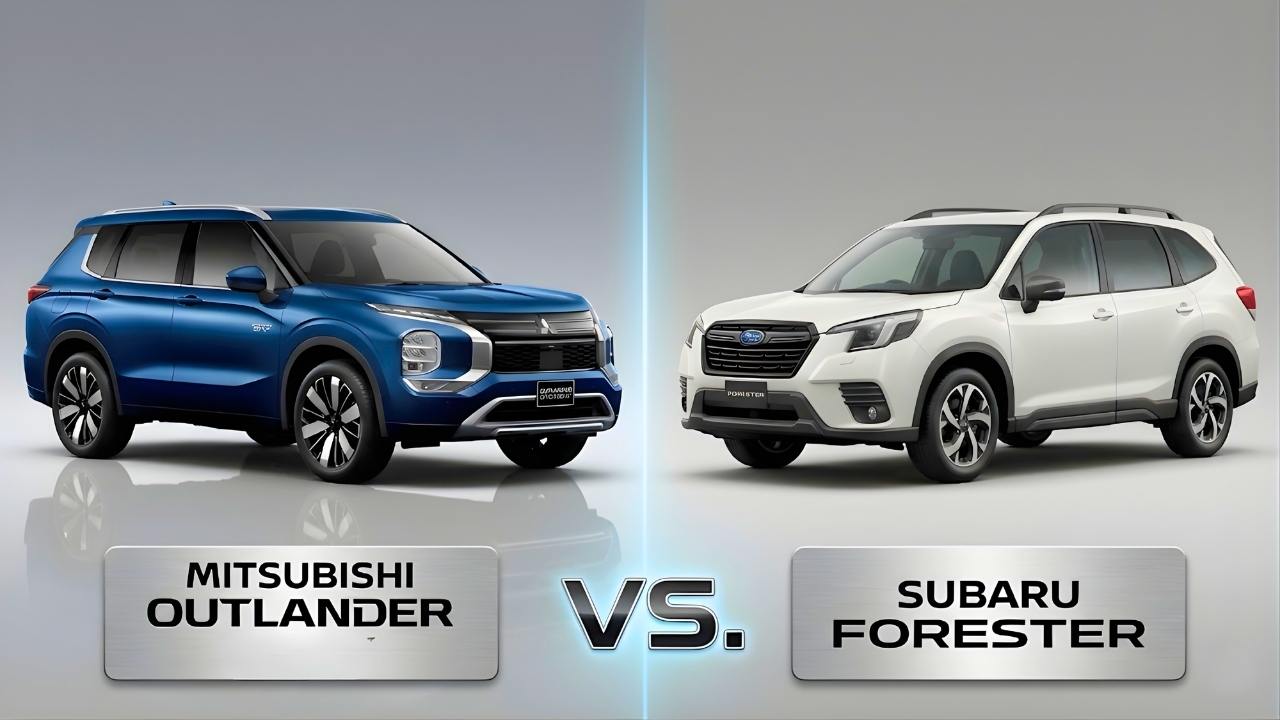
Both the 2026 Mitsubishi Outlander and the 2026 Subaru Forester are compact crossover SUVs, but the first one comes with a three-row layout and the second with only two rows. In Canada, the Outlander is available in 7 different variants with the starting price of $36,398, while the Forester is available in 6 trims with $34,195.
They are totally different from one another, whether it’s in terms of interior and features, exterior and design, dimensions and space, or power train and performance. We have come up with a comparison between them; it will guide you on which one you should go with if you are considering having any of them.
Interior & Features
The Outlander has a premium and luxury-like cabin with soft-touch materials; it features a panoramic sunroof that makes the cabin feel more spacious. It gets triple-zone climate control, all seats are heated, front ones are also ventilated, and drive ones feature memory power.
It has a 12.3-inch touchscreen infotainment system that supports wireless Apple CarPlay & Android Auto with a Yamaha premium sound system, digital driver display, and head-up display. It also features wireless charging, a 360° camera, a digital rearview mirror, and multiple storage spaces for convenience.
On the other hand, the Forester features a practical and spacious cabin with an upright design with large windows. Premium materials are used for seating with soft touches, and dual-zone climate control, heated front seats, and power-adjustable seats are comfort features. It also gets wireless charging.
The 11.6-inch vertical touchscreen is available for infotainment that supports wireless Apple CarPlay & Android Auto and equipped with the Harman Kardon premium sound system and a 12.3-inch digital instrument cluster. Additionally, features are keyless entry, push start, in-car Wi-Fi, and Bluetooth with voice controls.
Exterior & Design
The Outlander features a large and aggressive grille with chrome elements that gives a premium and powerful road presence. It gets slim DRLs on top, and main headlights are placed below that reflects its sharp and futuristic lighting signature.
It has a long body and upright stance, prominent shoulder lines, and chrome window surrounds with 20-inch alloy wheels. At the rear, it features LED taillights with a horizontal layout with a clean tailgate, giving a wide, stable, and upscale look from behind.
While the Forester gets a simpler grille with chrome accents, which makes it more practical than flashy, the front fascia gets Subaru’s signature C-shaped LED headlights and adaptive LED system for better night visibility.
It has a tall roofline and straight body panels and features black body cladding around wheel arches, and it turns on 17-19 inch alloy wheels that further improve efficiency. The rear also gets a rugged look with a simple tailgate design and functional LED taillights.
Dimensions & Space
The Outlander is larger compared to the Forester. Mitsubishi’s model measures 4720 mm, 2144 mm, 1745 mm, and 2705 mm in terms of length, width, height, and wheelbase; and Subaru’s model’s length is 4655 mm, width is 2062 mm, height is 1730 mm, and wheelbase is 2670 mm.
The Forester has a higher ground clearance of 220 mm compared to the Outlander, which measures only 210 mm. The Mitsubishi’s model has a boot space of 308 liters, and the Subaru’s one has 779 liters of cargo space, which can be extended up to 1822 liters and 1957 liters by folding seats, respectively.
Powertrain & Performance
The Outlander comes with a 1.5L turbocharged engine and mild hybrid system that generates 174 hp power and 206 lb-ft torque, which make it ideal for city driving and load carrying. Its drivetrain is AWD, which improves grip on bad roads, and its transmission is CVT, which is tuned for linear power delivery.
And the Forester gets a 2.5L naturally aspirated BOXER engine, which produces 180 hp power and 178 lb-ft torque. It features a symmetrical AWD configuration that is excellent for bad roads and off-road driving, and it does have a CVT transmission that focuses on control and not speed and provides a smooth driving experience.
The top speed, acceleration timing for 0-100 km/h, and fuel efficiency for the Outlander are 170 km/h, 10.5 seconds, and 8.7 liters for each 100 km of driving, while the Forester has a top speed of 204 km/h, 0-100 km/h acceleration timing of 8.3 seconds, and fuel efficiency of 8.3 liters for 100 km of driving.
If you are looking for family usability, a premium feel, a feature-loaded experience and comfort-focused driving, then go with the 2026 Mitsubishi Outlander; and if you value visibility and practicality, want a superior AWD system, better performance and capability and huge cargo space, choose the 2026 Subaru Forester.