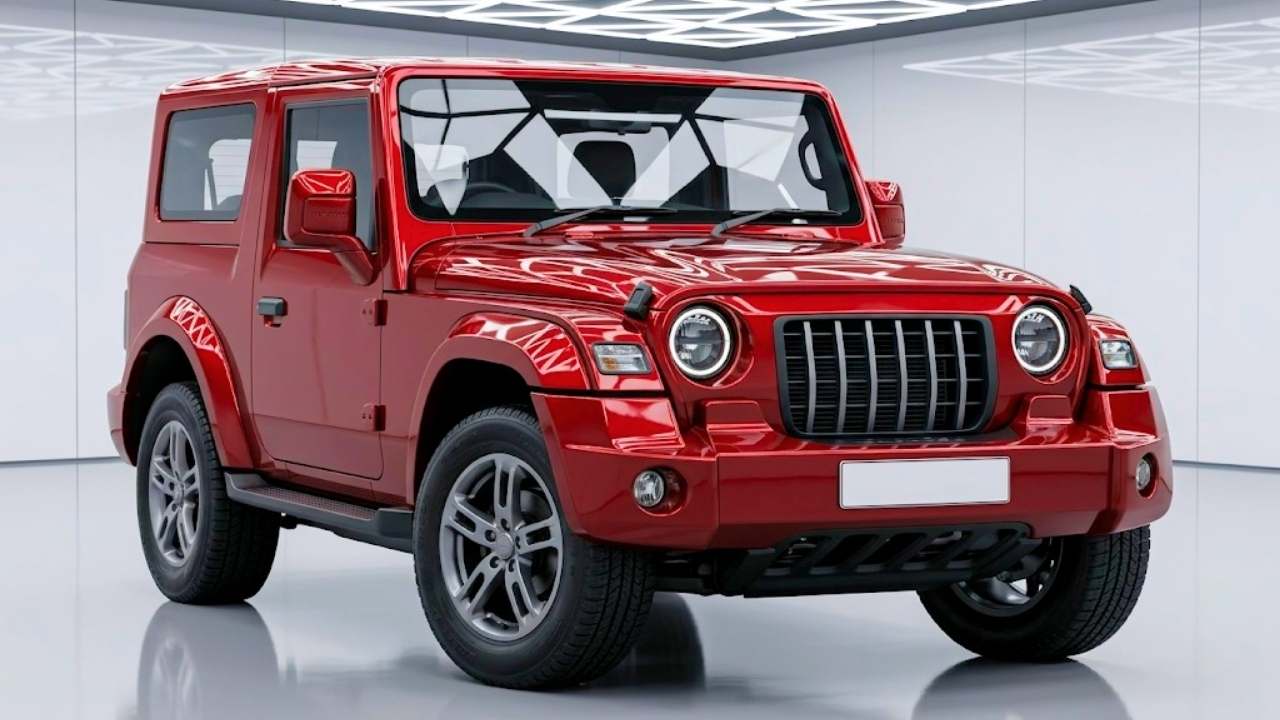
The Mahindra Thar facelift was recently spotted undergoing testing, revealing numerous details. It is expected to be launched in the Indian market by the end of 2026, with pricing projected to range between ₹10 lakh and ₹18 lakh, depending on the variant.
The testing sightings have brought many details to light; the Mahindra Thar facelift is set to feature a host of updates, drawing inspiration from the Mahindra Thar Roxx. Stay tuned to know what we get to know from the recent sighting and other details.
What details have emerged from recent test sightings of the Mahindra Thar facelift?
The Mahindra Thar facelift was spotted during testing, revealing numerous details regarding its design, as discussed below.

- The new front grille is going to look more modern, and that too with a split and more pronounced design.
- Now circular LED headlamps have been integrated in the grille.
- The old lightning setup has been removed, and safety LED drills have been added.
- The bumper has also been slightly changed, and the turn indicators have been made a bit modern.
- The lightning implements have also been updated, which gives it a more stylish appearance.
- Changes have also been made in the allowance designs, which are making its side profile stronger.
Will there be any changes to the powertrain and performance of the Mahindra Thar facelift?
No changes are expected regarding the powertrain and performance of the Mahindra Thar facelift; it is anticipated to remain identical to the existing models. It is set to launch in the Indian market with three engine options, including a 2.0-litre turbo petrol, a 1.5-litre diesel, and a 2.2-litre diesel. Their specifications are listed below.
2.0L Turbo Petrol

- Displacement: 1997 cc
- Power: 150 bhp
- Torque: 300–320 Nm
- Gearbox: 6MT / 6AT
- Drive Type: RWD / 4×4
- 0–100 km/h: ~10 sec
- Top Speed: ~155 km/h
- Mileage: ~13 km/l
1.5L Diesel
- Displacement: 1497 cc
- Power: 116 bhp
- Torque: 300 Nm
- Gearbox: 6MT / 6AT
- Drive Type: RWD
- 0–100 km/h: ~13–14 sec
- Top Speed: ~140 km/h
- Mileage: ~15–16 km/l
2.2L Diesel

- Displacement: 2184 cc
- Power: 130 bhp
- Torque: 300 Nm
- Gearbox: 6MT / 6AT
- Drive Type: 4×4
- 0–100 km/h: ~11–12 sec
- Top Speed: ~150 km/h
- Mileage: ~14–15 km/l
For the Mahindra Thar facelift, the two turbo-petrol engines are considered the better option for city use; if you are seeking better mileage along with highway driving capability, the 1.5-litre diesel engine is adequate; and if you require off-roading capability, the 2.2-litre diesel engine is the choice.
What are the space and dimensions of the Mahindra Thar facelift?
There are no changes to the dimensions or interior space of the Mahindra Thar facelift; it remains identical to the existing model. Its length, width, and height measure 3985 mm, 1820 mm, and 1855 mm, respectively, while its wheelbase stands at 2450 mm, providing better legroom for rear passengers, along with enhanced stability at high speeds.

It features a ground clearance of 226 mm, which further enhances its off-road capabilities. The facelift of the Mahindra Thar does have a three-door with a seating capacity for four people; the boot space can easily accommodate two large suitcases, but if the rear seats are folded down, the available space expands to 600 litres.
Are there any changes to the interior of the Mahindra Thar facelift as well?
We can expect to see some changes in the interior of the Mahindra Thar facelift. We have shared the expected details regarding these interior changes below.
- We can expect to see some upgrades in higher-end variants, including automatic climate control, ventilated front seats, wireless charging, keyless entry with push-button start, an auto-dimming IRVM and power-folding ORVMs, and Level 2 ADAS.
- It is expected to feature an updated touchscreen, accompanied by an improved user interface; furthermore, the addition of a more premium sound system is also anticipated.
- To enhance the convenience and comfort of the interior, superior soft-touch materials have been utilised, ensuring that occupants experience no inconvenience during long-distance travel.